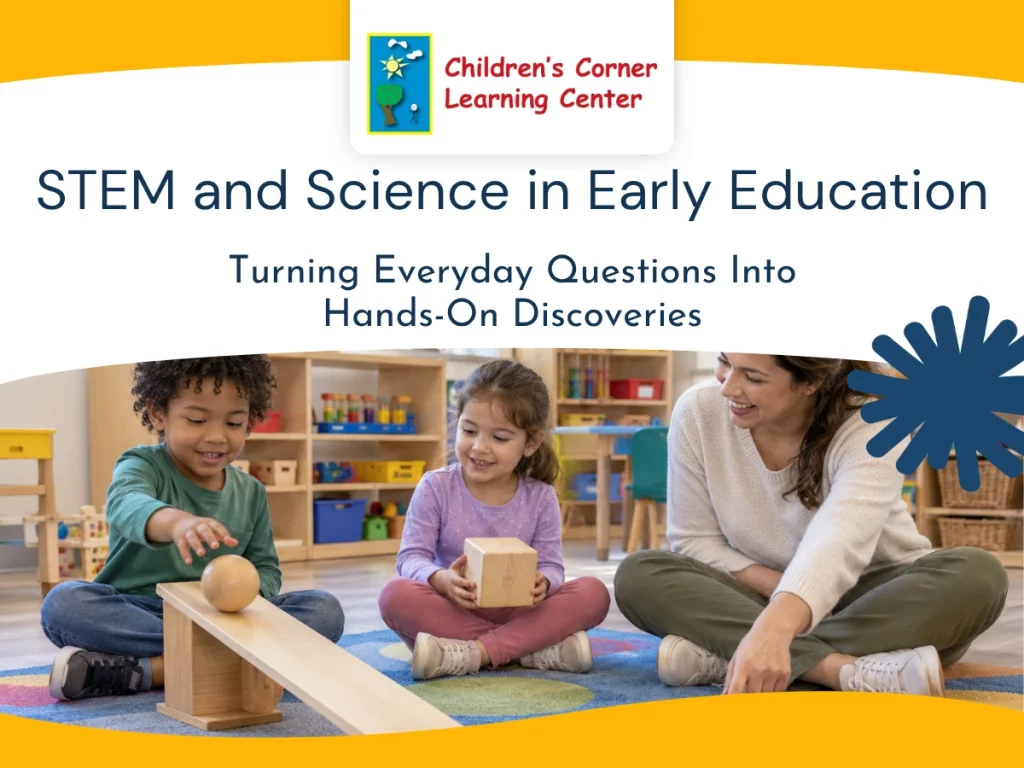
A STEM preschool in Hawthorne can help young children build curiosity, confidence, and early problem-solving skills through purposeful opportunities to explore the world around them. For preschoolers, science does not need to begin with complex concepts. It can start with observing what happens, asking questions, comparing objects, building structures, exploring nature, and testing simple ideas through play.
At Children’s Corner Learning Center in Hawthorne, play-based learning and hands-on activities are part of an environment designed to support children’s social, emotional, physical, and cognitive development. These active experiences can create meaningful foundations for future learning while allowing children to discover at a developmentally appropriate pace.
Hawthorne, NY, Daycare Centers: Creating Space for Curiosity and Discovery
When families consider Hawthorne, NY daycare centers, the learning environment can matter as much as the activities children do within it. Preschoolers benefit from spaces where they can investigate, make choices, use materials in different ways, and revisit ideas as their understanding grows.
STEM learning at this age is closely connected with curiosity. Children naturally want to know what objects do, why something changed, whether a structure will stay standing, or what they might find outdoors. A thoughtful preschool environment gives them opportunities to explore these questions through experiences appropriate to their developmental stage.
Turning Curiosity Into Early Learning
Everyday activities can introduce concepts connected with science, technology, engineering, and math without turning preschool into a formal academic setting. Children might strengthen early STEM thinking when they:
- Compare the sizes, shapes, or textures of objects
- Build and rebuild using blocks and other materials
- Sort items according to visible characteristics
- Observe changes in natural materials
- Explore balance, movement, and cause and effect
- Notice patterns during play and daily routines
The value lies not simply in reaching the correct answer. Children also benefit from noticing, wondering, experimenting, and trying again.
An Environment Designed for Active Participation
Children’s Corner describes its Hawthorne program as combining play-based learning with hands-on activities while providing age-appropriate materials, outdoor play, and opportunities for creative expression. The center also emphasizes social, emotional, physical, and cognitive development as interconnected parts of early learning.
This balance keeps exploration engaging while still serving a developmental purpose. When children can investigate materials themselves, they begin forming connections between what they see, what they do, and what happens next.
Science for Preschoolers in Hawthorne: Learning Through Questions and Experimentation
Science for preschoolers in Hawthorne can begin with something as simple as a child noticing a change and wanting to understand why it happened. Preschool science is most meaningful when children can observe, touch, move, compare, predict, and experiment within experiences that feel relevant to them.
These moments help children become active participants in learning rather than simply receiving information.
Building Early Scientific Thinking
Young children do not need formal scientific terminology to begin developing important thinking skills. An educator can support exploration by encouraging children to notice details, make predictions, describe what they see, and consider different possibilities.
A simple activity involving water, natural materials, building objects, colors, or movement can create opportunities to ask questions such as:
- What do you notice?
- What do you think will happen next?
- Which one feels heavier or lighter?
- What changed when you tried something different?
- Is there another way we could test that idea?
Questions like these encourage children to communicate their thinking while strengthening observation and reasoning.
Learning From the Natural World
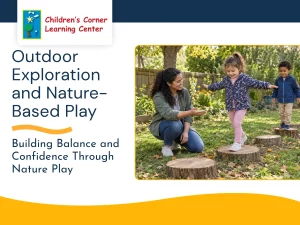
Outdoor experiences can also provide rich opportunities for early science learning. Leaves, plants, weather, soil, shadows, insects, and seasonal changes can encourage preschoolers to observe patterns and notice how the natural environment changes over time.
Children’s Corner’s Hawthorne program includes outdoor play, while its Pre-K offering gives children opportunities to explore the natural world, including gardening experiences.
These experiences can make scientific ideas more tangible. Instead of only hearing that plants grow, children can observe changes themselves. Instead of being told that objects behave differently, they can explore those differences through direct experience.
This approach helps science remain accessible, meaningful, and connected to the curiosity preschoolers already bring to their surroundings.
Hands-On Childcare in Hawthorne: Developing Skills Through Active Exploration
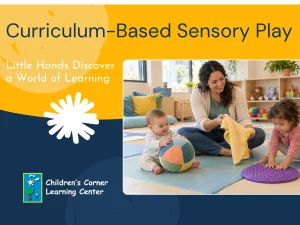
Hands-on childcare in Hawthorne gives preschoolers opportunities to learn by actively engaging with materials, ideas, and other people. This approach is especially valuable during early childhood because young children often develop understanding through doing, repeating, experimenting, and adjusting their actions.
A building activity, for example, can involve far more than stacking blocks. Children may consider size, balance, shape, position, stability, and sequence. If the structure falls, they can change their approach and try again.
One Activity Can Support Several Skills
Hands-on exploration can support multiple areas of development simultaneously. Depending on the activity, children may be strengthening:
- Fine motor skills as they grasp, arrange, pour, connect, or manipulate materials
- Early math concepts through counting, sorting, comparison, shape, and pattern
- Language skills as they describe observations and communicate ideas
- Problem-solving by testing different approaches when something does not work
- Social development when materials and discoveries are shared with peers
- Confidence as children see the results of their own choices and efforts
These connections are important because early development does not happen in isolated categories.
Allowing Children to Participate in the Process
An educator’s role in hands-on learning is not always to provide an immediate solution. Thoughtful guidance can give children enough support to remain engaged while still allowing them to investigate an idea independently.
Children’s Corner states that its preschool approach helps children build confidence and independence through group play and a curriculum designed to encourage curiosity and creativity.
When children have space to make choices and work through manageable challenges, the process itself becomes valuable. They learn that discovery may require patience, observation, cooperation, and more than one attempt.
How Early STEM Experiences Support Broader Preschool Development
STEM learning can contribute to much more than an early understanding of science or numbers. Active exploration can strengthen thinking habits that children use across many areas of preschool learning and later education.
When children ask questions, test possibilities, and observe outcomes, they are also practicing persistence. When they explain what they discover, they develop communication skills. When they build something with another child, they may need to cooperate, listen, share materials, and consider another perspective.
Developing Problem-Solving Confidence
Preschool is an important time for children to learn that not every challenge has an immediate solution. An activity that does not work as expected offers an opportunity to reconsider what happened and try again.
Educators can support this process by helping children focus on possibilities rather than immediately correcting their work. Over time, repeated experiences with manageable challenges can help children feel more comfortable experimenting.
This is an important part of developing confidence as a learner.
Connecting Exploration With Kindergarten Readiness
The skills developed through active exploration can also support the transition toward kindergarten. Children benefit from being able to listen, follow directions, participate in group experiences, communicate ideas, make choices, and remain engaged when a task requires effort.
Children’s Corner’s preschool program emphasizes confidence, independence, social interaction, and skills that help prepare children for kindergarten. Its curriculum encourages curiosity and provides a stimulating environment for learning and discovery.
STEM experiences can complement these broader goals by encouraging preschoolers to approach unfamiliar situations with curiosity. Rather than expecting children to know an answer, active learning helps them develop the confidence to investigate how they might find one.
Conclusion
Preschoolers learn a great deal by exploring what is directly in front of them. A question about why something moves, an attempt to build a taller structure, or an outdoor observation can become an opportunity to strengthen reasoning, communication, persistence, and confidence.
At Children’s Corner Learning Center in Hawthorne, play-based and hands-on experiences support a broader approach to child development that includes cognitive, social, emotional, and physical growth. The Hawthorne center is located at 1 Skyline Dr, Hawthorne, NY 10532.
Discover an early learning environment where curiosity has room to grow. Visit https://childrenscornergroup.com/book-a-tour/ or call (914) 354-3712 to learn more about Children’s Corner Learning Center in Hawthorne.