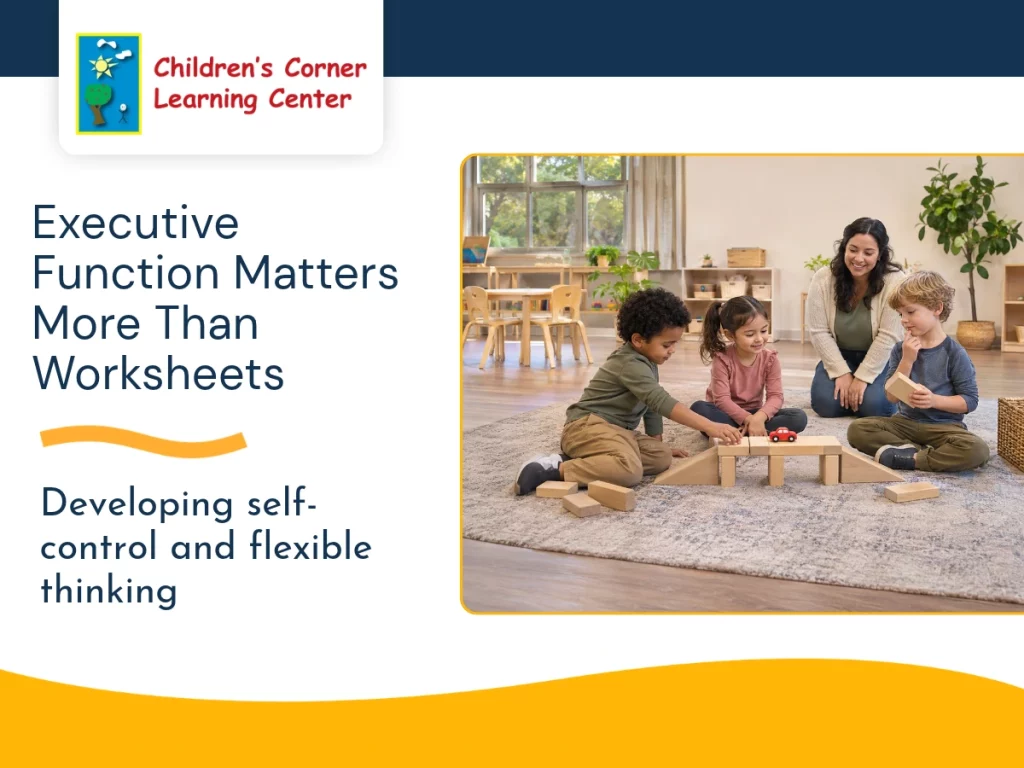
Understanding executive function in early childhood in Purchase, NY, helps parents recognize the learning that happens beyond a completed worksheet. When a child remembers the rules of a game or adjusts a plan after a block tower falls, they are practicing abilities that support classroom participation.
These skills help children use what they know, manage competing demands, and approach challenges with growing independence. Worksheets can offer opportunities to practice particular concepts, but they provide only a partial picture of readiness for school. Meaningful play and responsive adult guidance give children everyday opportunities to develop the skills that make learning possible.
Cognitive Development in Preschool: Purchase Families’ Guide to Executive Function
Executive function describes a group of mental skills that help children manage information and direct their actions toward a goal. These abilities develop gradually, beginning in early childhood and continuing into adulthood. Preschool provides opportunities to practice them with guidance, rather than expecting children to manage every situation independently. Three Skills That Work Together Executive function includes three closely connected abilities:- Working memory: Holding information in mind and using it, such as remembering where a puzzle piece belongs while searching for it.
- Inhibitory control: Pausing before acting, resisting a distraction, or waiting briefly for a turn.
- Cognitive flexibility: Adjusting to a different rule, considering another idea, or trying a new approach when the first attempt does not work.
What to Look for in a Purchase, NY, Daycare Center
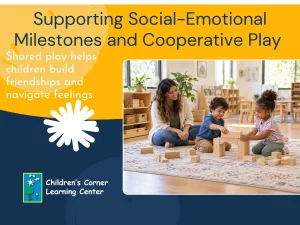
When visiting a Purchase, NY, daycare center, parents can look beyond displays of finished work to consider how children participate in the learning process. Observe the choices available to them, the challenges they encounter, and the support adults provide when an activity becomes difficult. Play That Requires Decisions Purposeful play gives children something to work toward. A pretend restaurant might involve choosing roles and remembering an order. A construction project may require children to decide which pieces will support a roof. Games also create opportunities to practice attention and self-control. During a simple stop-and-start movement game, children listen for a signal and adjust their actions. Matching games invite them to remember information from an earlier turn. Harvard’s Center on the Developing Child identifies age-appropriate games and playful interactions as opportunities to practice executive function skills. The challenge should remain appropriate to the child’s current abilities. Guidance That Leaves Room for Thinking An adult’s response can influence how much of a challenge the child gets to work through. Immediately fixing a leaning tower completes the task, but leaves little opportunity for the child to consider a solution. A teacher might instead draw attention to the base or demonstrate how to test whether a block is stable. Support can gradually decrease as the child becomes more capable. This approach allows children to participate in solving the problem without being left to struggle alone. Questions That Reveal the Learning Process Useful questions during a tour include:- How do teachers adjust activities when children need additional support?
- What opportunities do children have to make choices during play?
- How do teachers support children when a shared activity becomes frustrating?
- Can teachers describe progress that may not appear in completed work?
Developing Focus and Self-Regulation in Early Childhood
Focus and self-regulation in early childhood develop through repeated experiences with manageable expectations and supportive adults. A child may remain interested in a construction project yet find it difficult to follow a group instruction. Different situations place different demands on emerging skills. Focus Does Not Always Look Like Stillness A child who moves between a structure and a shelf to collect building materials may remain closely engaged with a plan. Similarly, children acting out a story can be attending to characters and events while moving around. Observing the purpose of a child’s actions provides more information than looking only at whether they remain seated. Useful questions include whether the child returns to a goal, follows what is happening, or responds to relevant information. Support Before Greater Independence Self-regulation involves managing attention, emotions, and behavior. Young children are still learning how to respond when something feels disappointing or overwhelming. Difficulty waiting or changing activities should not automatically be interpreted as deliberate misbehavior. Harvard’s guidance emphasizes adapting demands and providing supportive environments when executive function skills are still developing. For example, if a child becomes upset when a preferred toy is unavailable, an adult can acknowledge the disappointment, maintain the boundary, and help identify a next step. The child may need this support repeatedly before managing a similar situation more independently. Recognize Small Changes in Participation Progress may appear as:- Accepting help before abandoning a difficult activity.
- Following a familiar instruction with fewer reminders.
- Considering another child’s suggestion during play.
- Returning to an activity after a brief pause.