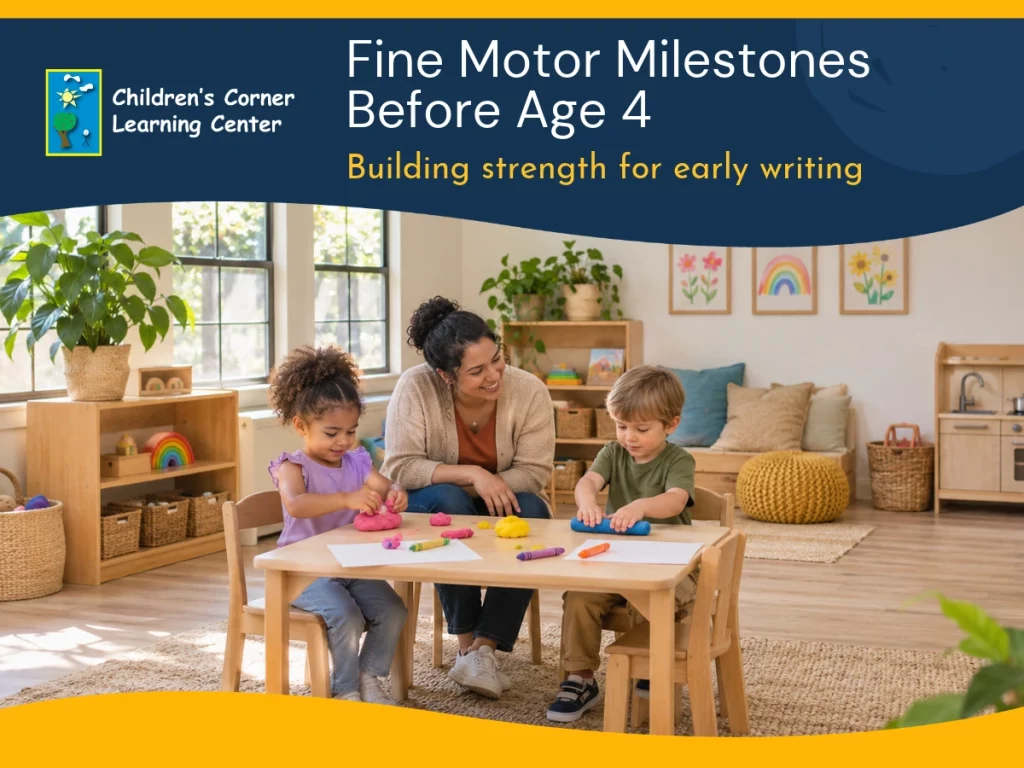
Parents researching fine motor skills preschool in Scarsdale, NY, often want to understand how everyday play prepares their child for early writing. Before age four, activities such as squeezing play dough, stacking blocks, and turning book pages help children practice the hand movements needed for greater independence.
These experiences support developing hand strength and coordination, providing a foundation for using crayons and other classroom tools. Progress varies from child to child, making patient encouragement especially valuable. Understanding how these skills develop can help parents recognize emerging abilities and offer meaningful practice opportunities without pressuring children to write before they are ready.
Toddler Developmental Milestones in Scarsdale: Fine Motor Progress Before Age Four
Understanding toddler developmental milestones in Scarsdale can help families recognize how small changes in hand control support growing independence. Fine motor development involves the smaller muscles of the hands and fingers, working together with vision to guide movement. Before age four, progress becomes visible through how children handle objects, feed themselves, and begin making purposeful marks.By Age Two: Using Both Hands Together
By age two, most children can hold an object in one hand while using the other, such as steadying a container while removing its lid. Eating with a spoon is another milestone, even when spills still happen. These emerging abilities show children beginning to coordinate their hands for a specific purpose.By 30 Months: More Controlled Movements
At around two and a half, everyday movements become more precise. Milestones include:- Turning book pages one at a time.
- Using the hands to twist objects, such as unscrewing a lid.
- Removing some clothing independently, such as loose pants or an open jacket.
By Age Three: Greater Purpose and Precision
By three, most children can draw a circle after being shown how and use a fork. A recognizable circle does not need to be perfectly round. The meaningful development is the child’s growing ability to observe a movement and reproduce it with increasing control.Approaching Four: An Emerging Writing Foundation
By age four, most children hold a crayon or pencil between their fingers and thumb rather than in a fist. Unbuttoning some buttons is another milestone. These developing skills help establish a foundation for later writing. Milestones offer reference points for understanding development. Notice how your child’s movements change over time, and share questions or concerns with their pediatrician.How Early Childhood Education in Scarsdale, NY, Supports Hand Strength
Early childhood education in Scarsdale, NY, can support hand strength through carefully chosen materials and opportunities for active play. For young children, building hand strength involves repeated experiences with pushing, pulling, squeezing, and manipulating objects. A supportive classroom gives these movements a meaningful purpose while allowing children to participate at their own level.Materials That Encourage Active Hand Use
Different materials offer different amounts of resistance. Soft dough changes shape under gentle pressure, while connecting construction pieces requires a more deliberate push. Working with varied materials gives children opportunities to adjust how much force they use. Useful classroom materials can include:- Play dough for pressing, squeezing, and pinching.
- Large interlocking blocks that children connect and separate.
- Washable sponges for squeezing during supervised water play.
- Age-appropriate tongs for transferring large, lightweight objects.
Teacher Guidance That Matches Each Child
Thoughtful support begins with observing how a child approaches a task. A child who struggles to separate construction pieces may benefit from larger, easier-fitting materials. Another may be ready for a task that requires more controlled pressure. Teachers can demonstrate a movement, allow time for an independent attempt, and adjust the challenge when needed. Brief, repeated opportunities help keep practice manageable and engaging.Strength as Part of a Broader Foundation
Hand strength is one part of using classroom tools successfully. Children also need coordination and practice using both hands together. For example, holding a container steady while placing objects inside gives each hand a different role. For families exploring preschool options, asking how teachers select materials and adapt activities can offer insight into how a program supports these developing abilities.Pre-Writing Activities for Preschool Children in Scarsdale
Pre-writing activities for preschool children in Scarsdale can introduce purposeful mark-making without requiring children to form letters. These experiences give children time to explore how their movements create lines, curves, and shapes. The emphasis is on building control and interest through activities that stay enjoyable and appropriate to each child’s abilities.Begin With Large, Comfortable Movements
A large sheet of paper gives children room to experiment without the demand of staying inside a small space. Children can make broad marks with washable crayons, then explore shorter lines or rounded movements as their control develops. An adult might demonstrate a single movement and invite the child to try it. Drawing alongside a child provides an example while leaving room for independent exploration.Offer Different Ways to Make Marks
Varied surfaces and tools can help sustain interest. With adult supervision and age-appropriate materials, options include:- Water painting: Use a brush and water to make marks on outdoor paving.
- Simple drawing paths: Invite children to draw a line connecting two large pictures.
- Chalk exploration: Make straight lines, curves, or circles on a suitable outdoor surface.
- Shared drawing: Draw a simple shape, then give the child space to try their own version.
Keep Expectations Focused on Exploration
By age three, drawing a circle after a demonstration is a recognized milestone. This does not mean every drawing should resemble a finished shape or lead immediately to letter practice. Notice the process: a child may begin making more deliberate marks, adjusting a movement, or returning to drawing with greater interest. Acknowledge those efforts without repeatedly correcting the result. End the activity when interest fades, so early writing experiences stay positive.Supporting Fine Motor Independence Through Daily Routines at Home
Daily routines give children meaningful reasons to use their developing hand skills. Opening a familiar container or helping with clothing connects practice to something they want to accomplish. At home, the most useful starting point is often a small part of an existing routine, with enough time for the child to participate.Make Space for Self-Care
Dressing offers opportunities to practice grasping, pulling, and coordinating both hands. Begin with manageable tasks, such as removing an open jacket or pulling down loose-fitting pants. These abilities are included in developmental guidance for around 30 months. An adult can complete the difficult part while leaving a simpler step for the child. For example, helping an arm into a sleeve may allow the child to finish pulling the sleeve into place.Give Children a Role at Mealtimes
Using utensils provides regular practice with grasp and controlled movement. Eating with a spoon is a milestone by age two, while using a fork appears in guidance for age three. Keep participation manageable:- Offer child-sized utensils suited to the food.
- Use stable dishes that are easy to reach.
- Allow time for independent attempts.
- Provide help when frustration interrupts the meal.