Families exploring gross motor development daycare in Yorktown, NY, may picture children running across a playground, but meaningful movement takes many forms. Stepping over a low obstacle, stopping a rolling ball, or bending to examine a leaf all help children develop control of their large muscles.
Fall offers an inviting setting for these experiences, with changing colors and seasonal discoveries that give children reasons to move. With thoughtful play opportunities and patient encouragement, early childhood programs can help children build physical skills while making decisions, exploring their surroundings, and becoming more comfortable with what their bodies can do.
Outdoor Play at Preschool in Yorktown: Building Balance, Strength, and Coordination
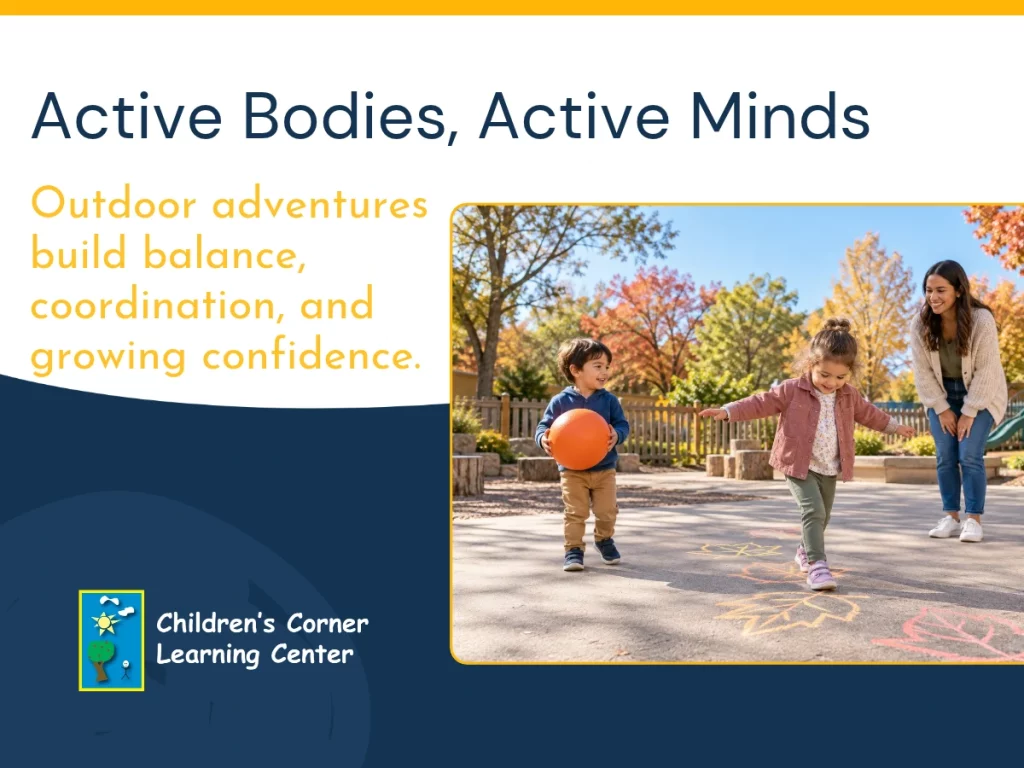
A child slows down before stepping across a chalk line, stretches their arms outward, and carefully shifts their weight. What looks like a small moment of playground play involves balance, coordination, and planning. Outdoor play at preschool in Yorktown can give children repeated opportunities to practice these skills in enjoyable, manageable ways. Seasonal activities work best when the movement has a clear purpose and children have room to explore without pressure to perform. Follow a Fall Movement Path A simple path drawn on a clear, dry surface can invite different movements. Children might walk along a winding line, step between large chalk leaves, and bend to touch a pretend pumpkin patch. Each part offers a different challenge:- Walking along a line gives children practice controlling their steps.
- Stepping between shapes invites them to judge distance.
- Bending and standing help children shift weight and maintain balance.
- Changing direction encourages awareness of the space around them.
A Yorktown Heights Child Care Center: Connecting Movement With Thinking and Cooperation
A movement game gives children more to consider than where to put their feet. They may need to remember a direction, choose a route, or coordinate their actions with a friend. A Yorktown Heights child care center can use purposeful play to bring these physical, social, and thinking skills together. The strongest opportunities keep instructions manageable and give children time to respond. Make a Plan, Then Try It Imagine a pretend delivery game in which children move lightweight “harvest baskets” between two marked spaces. Before beginning, an adult might ask, “How can you carry your basket around the cones?” Children can point to a route or explain their plan, then see how it works. If a turn feels too narrow, they can choose another way. The thinking stays connected to a real action. Children can notice a problem, adjust, and try again. Practice Listening Through Movement A familiar stop-and-go game can invite children to listen for a cue and change their movement. Begin with just two clear directions, such as walking when an adult says “go” and pausing when they say “stop.” As children become comfortable, an adult might invite them to:- Choose a different movement for the next round.
- Take a turn giving the familiar cues.
- Describe how they found enough space to stop safely.
Early Childhood Wellness in Yorktown, NY: Making Fall Outdoor Time Comfortable
Enjoyable outdoor play depends partly on the routines surrounding it. A child who feels uncomfortable, needs a drink, or is unsure how to ask for a break may find it harder to participate. Supporting early childhood wellness in Yorktown, NY, includes helping children recognize these needs and seek assistance. Fall is a useful time to review practical routines as conditions change throughout the day. Prepare for the Conditions Comfortable layers give adults options as the temperature changes. Well-fitting footwear helps children move without repeatedly stopping to adjust loose shoes, while spare clothing provides an option when clothes get damp. Before play begins, adults should check the activity area for slippery leaves, puddles, and other obstacles. A familiar route may need adjusting after rain. Outdoor plans should reflect current weather and air quality. When outdoor time isn’t suitable, an indoor movement game can offer another chance to stretch, balance, and move. Make Breaks Part of Participation Children benefit from knowing that they can pause without losing their place in the experience. Offer access to drinking water and a comfortable place to rest, with adults attentive to signs that a child needs support. Simple prompts can help:- “Would you like some water before we continue?”
- “You can rest here and watch for a moment.”
- “Tell me if your clothes feel wet or uncomfortable.”
Supporting Each Child’s Movement Confidence at Children’s Corner Learning Center
One child may approach a new movement activity immediately, while another watches several rounds before joining. Both responses give adults useful information. Supporting physical confidence begins with noticing what interests a child, what feels manageable, and where reassurance or an adjustment could help. Children’s Corner Learning Center in Yorktown Heights, located at 2051 Baldwin Road, emphasizes individualized learning and communication with families. Its published approach recognizes that children develop at different rates and need experiences suited to their evolving abilities. Offer Different Ways to Join An inviting movement experience can have several entry points. During a ball game, one child might roll toward a nearby target while another tries from farther away. A child can participate from a stable seated position when that suits their needs. Changing the distance, equipment, or pace can preserve the activity’s purpose while making participation more accessible. Adults can offer a choice: “Would you like to start here or closer to the basket?” This gives the child some control over the challenge. Recognize Progress That Matters to the Child Useful observations go beyond who runs fastest or jumps farthest. A child may show progress by:- Returning to an activity they previously avoided.
- Finding a steadier way to carry an object.
- Asking for support before trying something unfamiliar.
- Adjusting their movement around another person.